
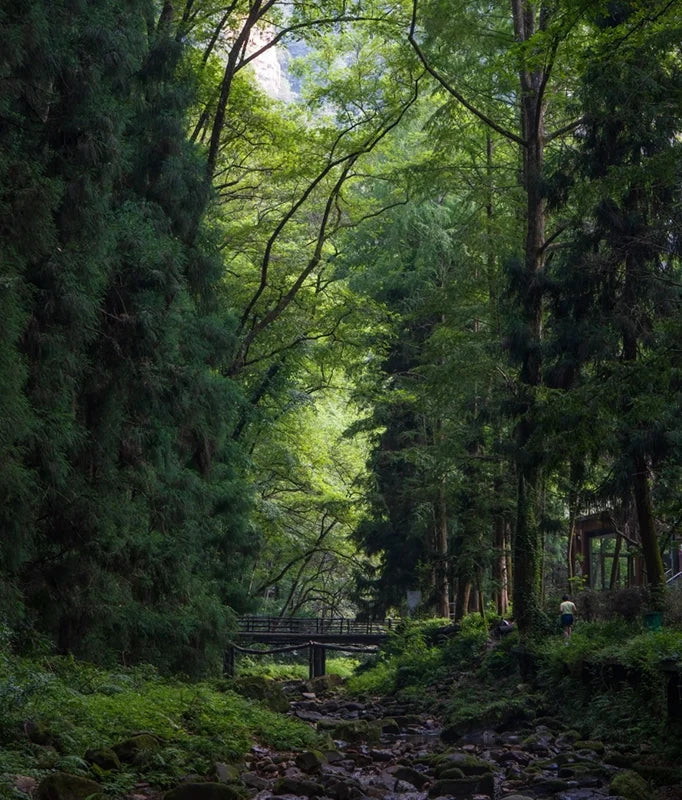
If Yuanjiajie and Tianzi Mountain let you look across the peaks from above, this route takes you into the landscape below.
There are no glass bridges or dramatic cableway rides here. Instead, you walk beside clear water, through shaded forest and beneath tall sandstone cliffs. You hear the stream, see light moving through the trees and occasionally catch a towering peak rising behind the valley.
As a local Chinese guide, I like to place this walk on the second day of a Wulingyuan itinerary. The first day can be spent above the mountains, while the second lets you slow down beside the water.
This is not a viewpoint that you visit and leave. It is a forest walk that rewards a slower pace.
Where Is the Stream?
The route is located inside Zhangjiajie National Forest Park and forms one of the best-known landscapes in the wider Wulingyuan area.
The official local tourism website describes the route as approximately 7.5 kilometres long, with a full walk generally taking about two to three hours. The far end is close to the Wulingyuan East Gate area.
The stream takes its name from Golden Whip Rock. Along the route, you pass forests, water, cliffs, sandstone pillars, and viewpoints named after Chinese legends and imagination.
UNESCO describes the wider heritage property as containing more than 3,000 quartz-sandstone pillars. Here, you experience them from the valley floor rather than from a distant summit viewpoint.
Who Is This Walk Best For?
I recommend it for: Travellers who enjoy forests and streams;
- Visitors who prefer gentle walking to steep climbs;
- Families wanting a natural route;
- Landscape photographers;
- People who want a slower day
- Travellers who have already visited Yuanjiajie and Tianzi Mountain.
The full distance is not extremely difficult, but 7.5 kilometres is still a meaningful walk. With older adults or children, I would start with a shorter section and decide later whether to continue.
What Will You See?
Commonly listed sights include:
- Mother-and-Child Peaks;
- Golden Whip Rock;
- Eagle Protecting the Whip;
- Master and Disciple Learning Scripture
- Longevity Spring;
- Purple Grass Pond;
- Meeting of Thousands;
- Shuiraosimen.
English translations can vary between maps and guides, but the route follows the same forest-and-stream landscape.
1. Golden Whip Rock
Golden Whip Rock is one of the signature formations and the source of the route’s name.
From the water's edge, the cliff looks much taller than it does in photographs. I often ask international visitors to look up before taking out their phones. Standing at the bottom of the valley gives you a much better sense of the scale.
2. Eagle Protecting the Whip
From a particular angle, one formation resembles an eagle spreading its wings beside Golden Whip Rock.
Chinese scenic areas often name rocks after animals, people or legends. You may not see the eagle immediately because its shape changes with your position, the light, and the weather.
A local guide or park sign can help you find the intended angle.
3. Purple Grass Pond
This is a pleasant area where water, rocks and forest come together.
The wider section of the stream can be a good place for a short rest, especially on a warm day. I personally like stopping here for water and taking a moment to notice the small details: sunlight on the surface, leaves moving above the stream and the sound of water around the stones.
4. Meeting of Thousands
This formation appears farther along the route, where two peaks face each other across the valley.
The name suggests people meeting again after a long separation. It is a good example of how Chinese place names often add emotion and storytelling to natural scenery.
5. Shuiraosimen
Shuiraosimen is an important point near the end of the route. Water, cliffs and several scenic routes meet here.
It can also be a practical point for deciding whether to continue, transfer to a scenic shuttle or leave the area. Check the current transport instructions upon arrival, as internal operations may change.
Where Should You Start?
A common full-route direction is:
Enter near the South Gate of the Forest Park and walk toward Shuiraosimen and the Wulingyuan East Gate side.
This is not a simple loop. Before starting, decide:
- Which entrance will you use;
- Whether you want to walk the full distance;
- How will you leave at the far end;
- Whether you need a shuttle to return to your hotel or continue to another attraction.
If you only want the most beautiful section, walk partway and return. This is often better for families, older visitors and travellers with limited time.
How Long Does It Take?
The full route
Official local tourism information commonly uses 7.5kilometress and around two to three hours as a basic estimate.
In practice, allow more time if you:
- Take photographs;
- Stop often;
- Travel during a busy period;
- Walk slowly;
- Have children or older adults with you;
- Encounter wet conditions.
For a relaxed experience, I would allow three to four hours rather than planning around the shortest possible time.
A shorter section
You can also:
- Walk to Golden Whip Rock and return;
- Continue to Purple Grass Pond and turn back;
- Walk toward Meeting of Thousands and decide later;
- Combine a shorter section with another attraction.
For most first-time visitors, a comfortable partial route is better than treating the full distance as a test.
One-Day Itinerary Options
Option 1: Half-day walk
Best for:
- Families;
- Older visitors;
- Travellers with limited time;
- Anyone who does not want a full-length hike.
Suggested structure:
- Enter near the South Gate;
- Follow the stream;
- See Golden Whip Rock, Eagle Protecting the Whip and Purple Grass Pond;
- Continue only if you still feel comfortable;
- Return or use the current scenic transport route.
Option 2: Full walk
Best for:
- Travellers who enjoy a slow pace;
- Visitors with reasonable fitness;
- People who want the complete forest-and-stream experience;
- Those not combining too many other attractions that day.
Start early if possible. Beginning a long walk late in the afternoon leaves less flexibility if you move slowly or encounter delays.
Option 3: Combine It with Huangshizhai
The two attractions are both on the southern side of the forest park and can sometimes be combined.
You could visit Huangshizhai first and walk part of the stream afterwards, or reverse the order. Huangshizhai includes more stairs, so I would not overfill the day if you were already tired from the previous day.
How Difficult Is the Walk?
The route is generally easy to moderate, but it is not effortless.
Expect:
- Uneven stone paths;
- Wet surfaces;
- Some stairs and slopes;
- Several hours of continuous walking;
- Humidity near the water;
- Crowds during busy periods.
Fitness guide
- Light: A short section near the entrance;
- Moderate: Walking to Purple Grass Pond or Meeting of Thousands;
- More demanding: Completing the full 7 kilometres and continuing to another attraction.
If you do not walk regularly, begin slowly and check how your body feels before committing to the full route.
Is It Suitable for Older Adults and Children?
Yes, if you control the distance.
Compared with Huangshizhai or Yangjiajie, the route has fewer sustained steep climbs, which is why many families choose it.
However:
- The full route is long;
- Strollers are not practical;
- Stones can become slippery;
- Some streamside areas have drops;
- Resting places may be busy during peak periods.
With children or older adults, I suggest:
- Walking only the most scenic section;
- Carrying enough water;
- Bringing small snacks;
- Avoiding another long hike on the same day;
- Leaving time for breaks and the return journey.
Best Season to Visit
Spring
Fresh greenery and post-rain mist create a lively atmosphere.
Summer
The valley is often cooler and shaded than the city, but humidity, rain and visitor numbers can be high.
Autumn
Temperatures are usually pleasant, and the light is good for photography.
Winter
The route is quieter, but mornings can be cold, and stones may be damp or slippery.
Spring and autumn are my favourite seasons for this walk. If you visit in summer, start early and carry water and rain gear.
Is It Worth Visiting in the Rain?
Light rain or the period after rainfall can be excellent for photography.
The rock surfaces become darker, the water sounds stronger,r and mist may gather between the cliffs. To me, the valley after rain feels especially close to the atmosphere of a traditional Chinese landscape painting.
However, avoid continuing during:
- Thunderstorms;
- Strong winds;
- Rising water levels;
- Very slippery surfaces;
- Official safety warnings;
- Extremely poor visibility.
Do not ignore safety simply because you want to see mist. Follow park staff if they ask visitors to stop or turn back.
What Should You Bring?
I recommend:
- Shoes with good grip;
- A lightweight rain jacket;
- Drinking water;
- Energy bars or nuts;
- Sun protection;
- A power bank;
- Tissues;
- A waterproof pouch;
- Personal medication.
Do not bring large luggage. The route is much more enjoyable with a light daypack.
Food and Restrooms
There are usually food, rest and restroom facilities near entrances and major service points, but the choices are more limited than in town.
Before starting, I suggest:
- Using the restroom at the entrance;
- Buying water;
- Carrying a simple snack;
- Not assuming you will find familiar Western food;
- Taking all rubbish to the proper disposal points.
Visitors with special dietary requirements should prepare a few suitable snacks in advance.
Golden Whip Stream or Yuanjiajie?
They offer completely different experiences.
This stream route
- Valley walking;
- Forests and water;
- Close-up cliffs;
- A relatively gentle rhythm;
- Better for slow travel.
Yuanjiajie
- High viewpoints;
- Concentrated sandstone pillars;
- More dramatic long-distance views;
- Internal transport such as buses or elevators;
- Better for visitors seeking the iconic mountain scenery.
If you only have one day:
- Choose the stream if you prefer forests and walking;
- Choose Yuanjiajie if you prefer high viewpoints and classic peak photography.
With two days, I recommend visiting both.
Practical Advice for International Visitors
Save the Chinese names
Keep these names on your phone:
- 金鞭溪
- 金鞭岩
- 紫草潭
- 千里相会
- 水绕四门
- 森林公园门票站
- 武陵源标志门
Chinese names are usually more useful when using maps or asking staff for directions.
Do not drink directly from the stream
Even if the water looks clear, use bottled or treated water.
Do not feed wildlife
If you encounter animals, do not feed, chase or approach them.
Be careful beside the water
Stones can be slippery. Stay on the marked path and do not step into the stream for a photograph.
Plan your exit
This is not a simple return loop. If you complete the route, you may leave from a different side and need a scenic shuttle or another transfer. Confirm the exit and return arrangements before starting.
Frequently Asked Questions
How long is the route?
Official local tourism information describes it as approximately kilometres, taking around two to three hours to complete. Photography, breaks, crowds and weather may extend the time.
Is it suitable for beginners?
Yes. It is generally gentler than Yangjiajie or Huangshizhai, though the full distance requires a reasonable level of endurance.
Do you need to walk the entire route?
No. You can walk to Golden Whip Rock, Purple Grass Pond, or Meeting of Thousands, then turn back depending on your energy and schedule.
Can you combine it with Huangshizhai?
Yes, but plan according to your fitness. Huangshizhai includes more stairs, so avoid making the day too ambitious.
Is it suitable in the rain?
Light rain and post-rain conditions can be beautiful. During thunderstorms, strong winds, or seriously slippery conditions, prioritise safety.
Is it suitable for older adults and children?
A short section is usually manageable, but the full route is long. Choose the distance based on the group’s actual fitness.
My Local Guide’s Recommendation
If I were walking with you, I would not rush.
I would let you listen to the stream first, then slowly notice the forest and cliffs. At Golden Whip Rock, we would look up at the pillars. At Purple Grass Pond, we would stop for water. If everyone still felt comfortable, we would continue toward the Meeting of Thousands.
I do not believe you must complete the full 7.5 kilometres for the walk to count.
For me, the most beautiful moment often comes before the end: walking under the trees, hearing the water become clearer, then looking up to see a peak rising behind the branches.
That is the experience I most want to share with overseas visitors. Do not treat the route as a task to complete. Just walk through the valley carefully and allow the landscape to meet you at its own pace.


Dejar un comentario
Todos los comentarios se revisan antes de su publicación.
Este sitio está protegido por hCaptcha y se aplican la Política de privacidad de hCaptcha y los Términos del servicio.