
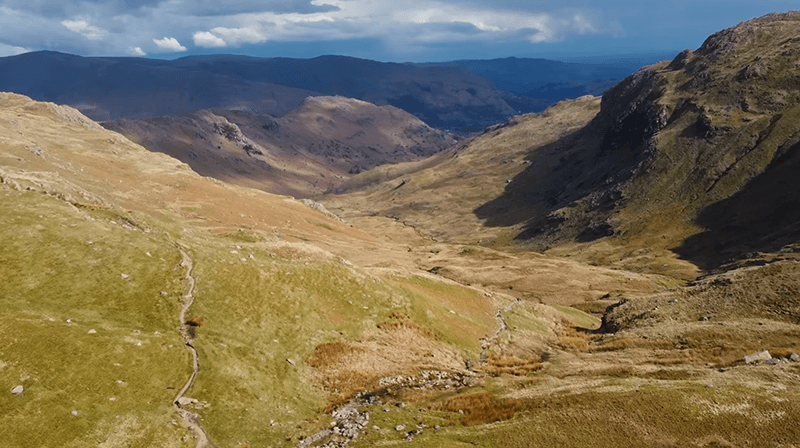
The Coast to Coast Path is one of the great long-distance walking routes in England. It crosses the country from St Bees on the Irish Sea to Robin Hood’s Bay on the North Sea, linking two very different coasts through mountains, valleys, farmland, moorland and old villages. The route is about 197 miles long, and it has long been associated with Alfred Wainwright, who described a coast-to-coast walk across northern England in the 1970s. Today, the Coast to Coast Path is officially recognised as a National Trail, giving it a stronger place among Britain’s classic walking routes.
What makes the Coast to Coast Path special is the feeling of travelling right across a landscape rather than simply following one region. The traditional direction is west to east, starting at St Bees. Many walkers begin by dipping a boot in the Irish Sea and picking up a pebble to carry across the country, then finishing at Robin Hood’s Bay by throwing it into the North Sea. It is a small ritual, but it gives the walk a clear sense of journey.
The first major section crosses the Lake District, and this is usually the hardest part. From St Bees, the route moves inland towards Ennerdale, Borrowdale, Grasmere, Patterdale and Shap. The scenery is spectacular, with high passes, lakes, rocky paths and open fells. It is also the section where weather and navigation matter most. Mist, rain and strong wind can change a day quickly, so walkers need proper waterproof clothing, good footwear and reliable maps.

After the Lake District, the Coast to Coast Path becomes gentler but not dull. The route crosses parts of the Yorkshire Dales, where the landscape opens into limestone country, green valleys, stone walls and historic settlements. Places such as Kirkby Stephen, Keld and Reeth are useful stops and give the walk a strong northern character. This middle section often feels more social and settled than the Lakes, with village pubs, guesthouses and classic Dales scenery.
The final part of the route crosses the North York Moors before reaching the east coast. This section brings wide heather moorland, forest tracks, big skies and long views. Eventually the path drops towards Robin Hood’s Bay, a steep old fishing village on the North Sea. Arriving there after nearly 200 miles is one of the most satisfying endings of any UK walk.
Most people take around 12 to 16 days to complete the Coast to Coast Path, although it can be walked in shorter sections. It is not as long as the Pennine Way, but it should not be underestimated. The Lake District days can be demanding, and poor weather can make even moderate distances feel serious. Accommodation should be booked early in busy months, especially in small villages where options are limited. Luggage transfer services are popular and can make the walk more comfortable.
The path itself is free to walk. Costs usually come from accommodation, food, transport, parking, baggage transfer and maps or guidebooks. Wild camping in England generally requires landowner permission, so most walkers use B&Bs, inns, hostels or campsites.
The best time to walk the Coast to Coast Path is usually from May to September, when daylight is long and services are easier to rely on. Spring and early autumn can be excellent, but the weather is never guaranteed. That unpredictability is part of the experience. The Coast to Coast Path is not just a line across a map; it is a proper crossing of northern England, from sea cliffs to mountains, from stone villages to moorland, and finally to the salt air of the east coast.


Commenta
Questo sito è protetto da hCaptcha e applica le Norme sulla privacy e i Termini di servizio di hCaptcha.